
Sabine Projected Versus Actual Release
TDCJ defines a projected release date as the date its Classification and Records Office calculates for leaving incarceration if parole does not occur sooner. It is a live estimate, not a promise. The offense date, nature of the conviction, time credits, mandatory-supervision eligibility, and Board action all affect the result. Maximum expiration is the calculated end of the sentence and may become the projected date when mandatory supervision is unavailable or denied.
A scheduled release date is later and more operational. It may appear after a favorable decision, approved plan, required program, certificate, and records audit. Actual release is the event recorded after the person leaves the custodian. For Sabine County Jail, that proof comes from the sheriff's booking and release record, not a TDCJ projection. A pretrial detainee has no sentence-based projected date. Bond, dismissal, a plea, trial, another hold, or a court order controls what happens next.
Find a Sabine County Release Date
The correct route depends on whether the person is pretrial, serving a county sentence, in TDCJ, or under state supervision. A Sabine County Jail case may never enter the state database. A transfer can end county custody while another agency continues to hold the person. Start with the sentence and custodian rather than searching every portal as if they covered the same records.
- Identify the exact person and custody episode. Use a booking number, cause number, TDCJ number, SID number, or accurate birth information when available.
- For state custody, search the TDCJ Online Inmate Search. Compare conviction county, court, offense, and identifiers before reading the dates.
- For a county sentence, ask the Sabine County Sheriff and sentencing clerk for the judgment, jail-time-credit finding, and release calculation.
- For a pretrial case, inspect the bond and docket. There may be no date until the court acts and all holds are resolved.
- Recheck detainers, consecutive terms, Board action, programs, and the result timestamp. Request the actual release record after departure.
The official form shows the proper state search fields. Open the live TDCJ search before relying on the captured interface.
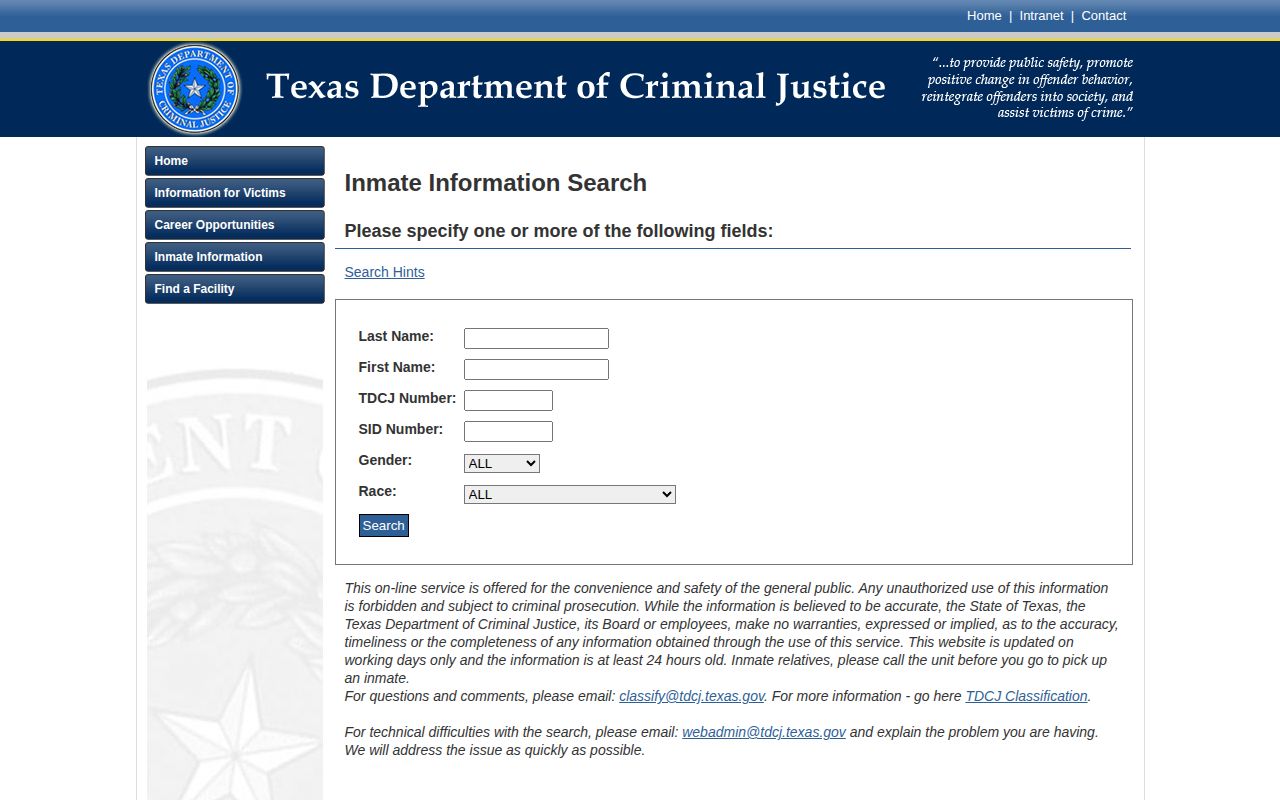
The image identifies the state portal, but a county-only booking needs the Sabine sheriff and court route.
Texas Good Time and Release Dates
Texas Government Code Chapter 498 governs TDCJ good-conduct time. Section 498.003 authorizes a classification-based system and permits added credits for diligent participation in qualifying work, agricultural, education, or vocational activity. Those credits operate only within the release law that applies to the conviction. They do not erase the sentence imposed in the judgment, guarantee parole, or override a flat-time requirement. Credits may be forfeited and, under the governing rules, restored.
Eligibility varies under Government Code Chapter 508. For certain serious offenses and deadly-weapon findings, section 508.145 can require actual calendar time equal to one-half of the sentence, subject to its qualifications and caps. Good-conduct time does not reduce that threshold. Texas should not be reduced to a claim that everyone serves 85 percent. That federal truth-in-sentencing benchmark is not a universal Texas parole formula.
County jail credit is a different calculation. Texas law requires applicable credit for time confined in the cause, while county good-conduct credit depends on sheriff policy and local law. No official Sabine County source reviewed publishes a local award rate. Ask the sheriff and sentencing court for the actual jail-credit calculation instead of importing a rule from another county.
- Parole eligibility
- The first date review may occur, not a promise of release.
- Projected release
- TDCJ's current calculated date, subject to change.
- Maximum expiration
- The calculated end of the sentence.
- Discharge
- The formal end of the sentence or supervision duty.
Why Sabine Release Dates Change
A projection rests on facts that can change. Compare each new result with its source and timestamp. A court may correct jail credit. TDCJ may update credits or its analysis of concurrent and consecutive sentences. Another custodian's hold may cause transfer instead of community release. Board action can also move the controlling date.
| Factor | Possible effect |
|---|---|
| Jail-credit correction | Moves the calculated date earlier or later |
| Credit forfeiture or restoration | Changes usable good time where law permits |
| New or consecutive sentence | Changes the controlling sentence calculation |
| Detainer or agency hold | May cause transfer rather than community release |
| Board denial or approval | Changes parole or mandatory-supervision processing |
| Program, plan, certificate, audit | Can delay physical release after approval |
TDCJ's Ombudsman states that after a release certificate reaches Classification and Records, audit and scheduling may take about 14 to 21 business days. A scheduled date can change without notice, even on that date. A favorable vote is therefore not a pickup time.
Confirm Sabine County Actual Release
Check the live TDCJ status when state custody is involved, then pair it with the release or discharge record. TDCJ IVSS can provide state custody and supervision alerts. IVSS-Counties is the separate portal for participating county jails. Neither alert system replaces the record created by the releasing agency.
For Sabine County Jail, request the date, time, release type, and receiving agency. A transfer is an exit from the jail, but it is not release to the community. The Sabine County released-inmate search and records path shows how to pair the sheriff event with the order that authorized it. A release to parole also differs from discharge because the state sentence continues under supervision.
If the ordinary TDCJ result has disappeared after full discharge, use the TDCJ email information route for incarceration history. Supply the full name and TDCJ number, or enough exact birth, age, and conviction-county information to identify the correct person.
Sabine Release Dates After 1996
Texas projected-date calculations divide sharply at September 1, 1996 for mandatory-supervision-eligible offenses. For an eligible offense committed before that date, the projected point is generally when flat time plus good time equals the sentence. For an eligible offense committed on or after that date, reaching the credit point is not enough. Discretionary approval by the Board of Pardons and Paroles is also required.
If the Board denies discretionary mandatory supervision, TDCJ may recalculate the projected date to maximum expiration unless a later review results in approval. For a noneligible offense, projected release generally matches maximum expiration and is based on flat time. Two people with equal sentence lengths can therefore have different dates because offense date, conviction, finding, credit class, and eligibility differ.
Use the actual judgment and TDCJ's official date definitions. Sabine County publishes no county-jail good-time formula, so a TDCJ calculation must never be copied onto a local sentence. The sheriff and court must supply that calculation.
TDCJ Dates for Sabine Cases
The TDCJ public detail may show current facility, projected release date, parole eligibility date, maximum sentence date, visitation eligibility, and parole-review information. Not every record has every field. Search first by the seven-digit TDCJ number or SID number because either is more precise than a name. Without an agency number, enter the last name and at least the first-name initial, then narrow the result with sex, race, and date of birth. Open the detail and compare the conviction county, court, and offense before using its date.
Online visibility has a boundary. TDCJ describes the search as covering people now in TDCJ custody or on parole or mandatory supervision. Someone who has fully discharged may no longer appear in the ordinary results. That absence does not erase the prison history. The email-information channel can provide enumerated incarceration information at no charge when supplied with the required identity details. It does not provide photographs.
Three labels often cause errors. Parole eligibility is only a review threshold. Projected release is the current Classification and Records calculation. Maximum expiration is the calculated sentence endpoint. A later scheduled date may follow Board action, required programming, plan approval, certificate issuance, and audit. None is a substitute for the completed release record.
Sabine County Sentence Calculations
The judicial record and jail record answer different parts of the question. The judgment states the sentence, and the jail-time-credit finding addresses confinement credited in that cause. The sheriff applies the county calculation and creates the operational release event. Ask for both when the expected date is disputed. A docket entry alone does not prove the minute custody ended, while a jail timestamp alone may not explain why the court authorized release.
Cause numbers also prevent crossed cases. One person may have more than one charge, hold, or sentence, and concurrent terms can be analyzed differently from consecutive terms. Ask which sentence controls the date and whether another agency has lodged a detainer. If a code appears on the sheriff record, request its legend and the receiving agency. “Transferred” must not be read as release to the community.
Public Record Search
Sponsored Results